
250 Years in the Making
|
On July 4, 2026, our nation will commemorate and celebrate the 250th anniversary of the signing of the Declaration of Independence. At the federal level, the celebration has been coordinated through the bipartisan efforts of the Semiquincentennial Commission since 2016.
Nationwide, the celebration is referred to as America250. Through the committee’s efforts, they have compiled upcoming milestones and opportunities to engage Americans and ensure that all can find ways to commemorate this historic moment.
At Catawba Valley Community College, CVCC’s Social Sciences Department has partnered with the CVCC Library to present a series of historically engaging discussions as part of the America 250 initiative.
On March 4th, 2026, instructor Ethan Brooks-Livingston offered a presentation on Women’s History Month & Stamp Act Commemoration, “Colonial Women and Resistance to the Stamp Act”. The British Parliament passed the Stamp Act on March 22, 1765, but due to intense colonial opposition, Parliament voted to repeal the Act a year later in March 1766.
Brooks-Livingston’s presentation examined how the Stamp Act taxed paper and ignited colonial protests. In 1765, colonists protested “taxation without representation,” invoking the language of liberty and natural rights. Yet women, enslaved and free African Americans, and Indigenous communities remained excluded from formal political power. Resistance unfolded not only in legislative halls and city streets, but also in kitchens, shops, and spinning rooms.
By transforming domestic labor into public resistance, women helped demonstrate that economic unity could challenge British authority. The Stamp Act crisis became a proving ground for boycott politics, revealing that the struggle for liberty ran through colonial homes as much as it did through legislative chambers.
Brooks-Livingston shared, “For our students and community, the 250th anniversary is less about a single moment in 1776 and more about understanding the long arc of American history. It invites us to explore why independence was pursued, how the language of liberty has shaped national debates, and how different communities have worked to claim a place within that vision. Commemoration provides an opportunity for honest engagement with both achievements and challenges, reminding us that history is not static. It is a conversation across generations about what freedom, equality, and democracy should mean in practice.”
Instructor Robert Carr presented on March 18, 2026, with a presentation on The Stamp Act of 1765 and the Awakening of the American Voice. This session commemorated the March 22 enactment of the Stamp Act and explored its historical significance in shaping early American resistance and revolutionary thought.
Presentations will continue into the fall semester, extending the celebration beyond the Fourth of July. Planned sessions include Dr. Christopher Moore discussing the religious beliefs of prominent founders of the United States, and Jeremy Wilson presenting on the Battle of Yorktown.
Dr. Moore shared, “America’s 250th anniversary provides an opportunity to reflect critically on the nation’s story. In 1936, Langston Hughes published a poem entitled “Let America Be America Again,” in which he writes, ‘I say it plain, America was never America to me, And yet I swear this oath—America will be!’ To Hughes, American history was the story of the perpetual tension between vision and reality. For that reason, I believe our commemoration of America 250 must grapple with that tension, as we reflect on the stories we’ve told ourselves about ourselves, and on the legacy we owe future generations.”
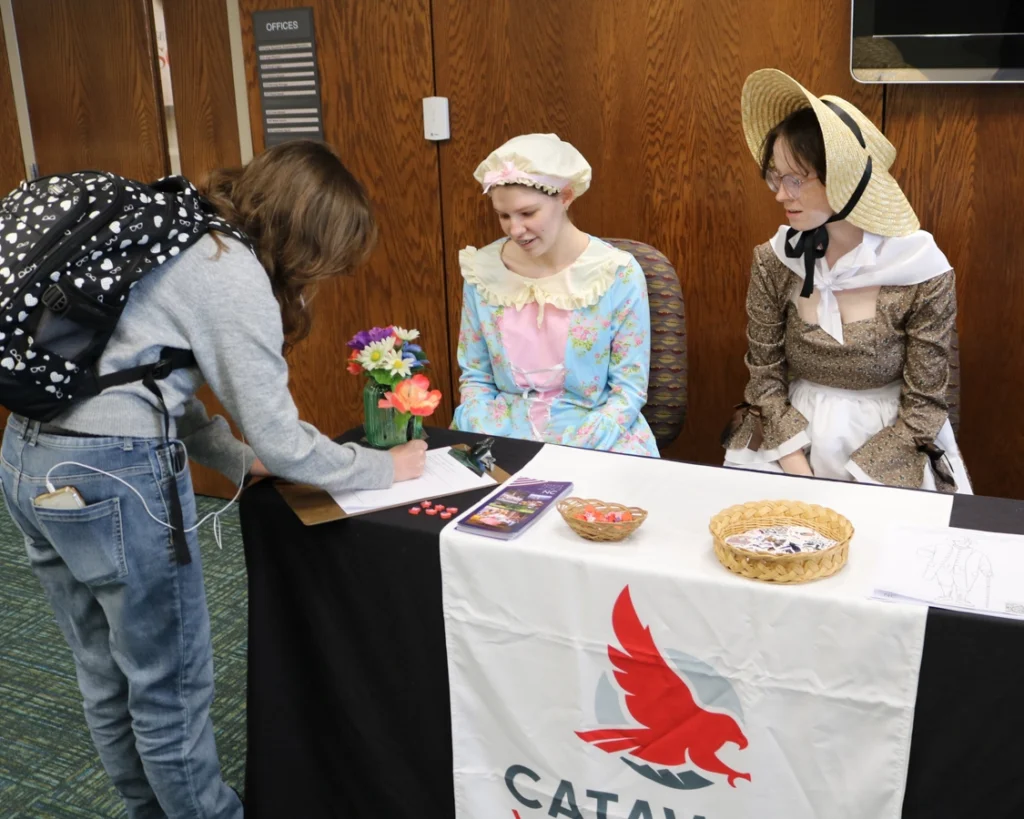
In addition to the history department’s lectures, the CVCC Library is hosting engaging activities throughout the year. Outreach and Instruction Librarian Anita McRary has gathered colonial-era costumes that students and faculty can wear as a fun way to connect with the history of the American Revolution.
McRary has also provided Flat Cornelius printouts for the CVCC community to participate in. The activity is part of the statewide initiative and introduces participants to revolutionary-era leader Cornelius Harnett. Born in Chowan County to an Irish immigrant family, Harnett built his early success as a Cape Fear merchant before entering politics in Wilmington in 1750.
Harnett rose to prominence by opposing the 1765 Stamp Act, helping to form the Sons of Liberty in Wilmington, and championing states’ rights. As chair of the committee that produced the 1776 Halifax Resolves, he helped make North Carolina the first colony to call for full independence from Britain. He later assisted in drafting the state’s first constitution.
He served in the Continental Congress from 1777 to 1780 but was captured during a British raid on Wilmington in 1781 and died shortly after his release. Harnett County, established in 1855, honors his legacy of leadership and commitment to independence.
McRary shared, “As we approach 250 years, I’m reminded that our nation was born out of disagreement — passionate, heated, deeply human disagreement. And yet, somehow, those imperfect founders created something that has held us together ever since. That story deserves to be celebrated, revisited, and yes, dressed up for. When you put on a costume and step into history, something clicks. Learning stops being a subject and starts being an experience.”
The college also joined in celebration of the United States Bicentennial in 1976, when campuses and communities nationwide commemorated 200 years of American independence.
Nearly fifty years later, that same spirit of reflection continues to encourage students, faculty, and the community to explore the nation’s past and consider how they can contribute to its ongoing story.