
From the Field to the Classroom
|
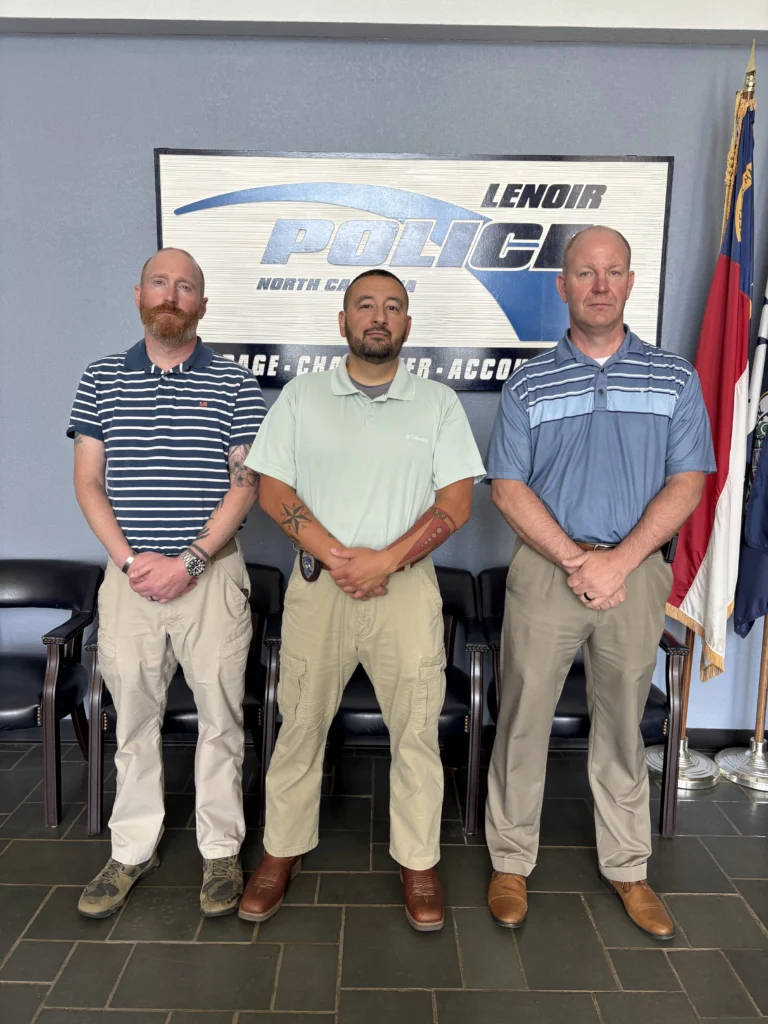
As graduation approaches, three seasoned law enforcement officers from the Lenoir Police Department are marking a meaningful achievement. John Howard, Brandon MacLeod, and Mark Barlowe each brought decades of real-world experience into the classroom as students in Catawba Valley Community College’s Criminal Justice program. Now, they are preparing to cross the finish line together.
While their paths into law enforcement began years ago, their return to education was sparked by a shared curiosity and a timely opportunity. For Howard and Barlowe, it started with a simple email flyer that made its way through their department. What initially seemed “too good to be true” quickly became a serious consideration after connecting with program staff and learning how the program was designed with working professionals in mind. MacLeod joined shortly after, bringing with him prior college credits and military experience that helped accelerate his journey.
Despite their extensive backgrounds, stepping back into the role of student came with some hesitation. For Barlowe, who had been out of school for more than three decades, the thought of tackling general education courses like math and English was daunting. “It was a little scary,” he admitted. But Barlowe found his own support system a little closer to home. With one son who had already earned his bachelor’s degree and another currently in college, he leaned on them for guidance throughout the program. Whether it was asking questions about coursework or getting help navigating certain subjects.
For all three officers, the program offered more than just a refresher on criminal justice concepts. It strengthened skills they use every day, especially communication. Writing became one of the most impactful takeaways. Whether drafting reports, reviewing documentation, writing search warrants, or even preparing press releases, the ability to communicate clearly and effectively is an essential part of their current roles. “Now I can sit down and write without even thinking about it,” Howard shared. “That wasn’t always the case.”
In fact, some of the most unexpected moments came from those very classes. Courses like sociology and English, which initially raised concern, became highlights of the experience. MacLeod found particular value in psychology, noting how it deepened his understanding of human behavior. Something directly applicable to his work in the field. “It made things click,” he said. “It helped explain why people think and react the way they do.”
For Howard, the experience also took on a more personal meaning at home. With his daughter currently in high school and taking college-level courses, the two found themselves sharing similar classes, turning it into a friendly competition by comparing grades and pushing each other to do better. What started as a return to school for professional growth became an unexpected way to connect and motivate one another. “Helping push her was more important than my own grades,” he said.
Balancing coursework with full-time careers and personal responsibilities was a common concern, but one they quickly learned to navigate. The flexibility of the online format and the understanding of instructors played a key role in their success. In many cases, instructors were willing to open modules early, allowing them to work ahead around unpredictable schedules and job demands. With just a few hours of coursework each week, they were able to stay on track while continuing to serve in demanding roles within their department.
As graduation nears, the sense of accomplishment is both personal and professional. For Barlowe, it represents a long-awaited return to something he once thought he had left behind. For MacLeod, it’s a strategic step toward future goals, including pursuing a bachelor’s degree. And for Howard, it’s not only about his own success, but also the example it sets within his family.
Their advice to others is simple: start. Whether just beginning a career or decades into one, there is value in continuing to learn. With the right support and commitment, the process is more manageable than many expect.
As they prepare to graduate, officers Howard, MacLeod, and Barlowe are proof that it’s never too late to invest in yourself. Their journey reflects not only dedication to their profession but also a commitment to growth, adaptability, and lifelong learning, qualities that define both great students and great officers.
For those interested in pursuing Criminal Justice programs at CVCC please visit the program page.