
Roll For Initiative
|
Dungeons and Dragons (D&D) is a popular cooperative, tabletop fantasy role-playing game (RPG) where players create characters and embark on adventures in a shared, imaginary world. Invented by Gary Gygax of Lake Geneva, WI, the game was published in 1974.
Over fifty years later, D&D continues to thrive, thanks to Netflix’s hit show “Stranger Things” and the best-selling video game “Baldur’s Gate 3.” The fifth edition of D&D was released in 2014 and launched a new wave of players through streamlining rules making the game easier for players to learn.
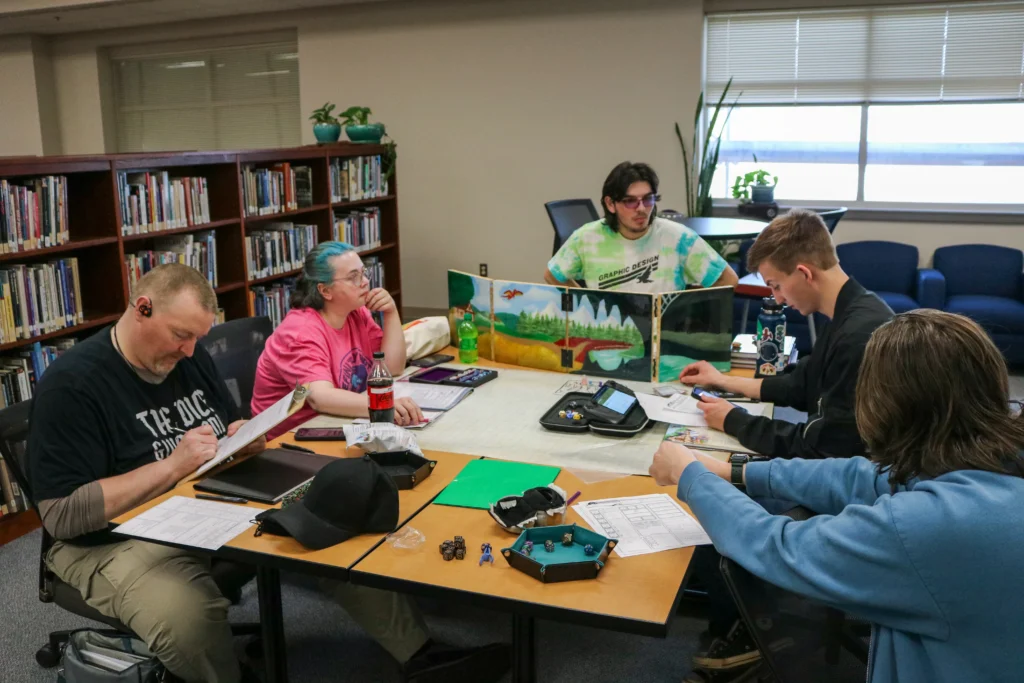
At Catawba Valley Community College, Dungeons and Dragons has become one of the most popular student clubs on campus. The D&D club offers community and space for camaraderie through shared interest in the game. Even if you have never played the game, the club welcomes all levels of experience and interest.
Rather than a traditional game, D&D approaches gameplay with a story, or in D&D terms, the campaign. Each campaign has a Dungeon Master (DM) who narrates by guiding the campaign and the players within it.
The group of players essentially tell a collective story, each controlling their own character as they guide heroes through dangerous quests to search for treasure, battle deadly foes, and even carry out daring rescues.
The adventure itself is only limited by the imagination of the players around the table. All that you really need to get started is a group of friends, a few supplies, and a Dungeon Master.
The Dungeon Master (DM) is the primary storyteller and creator of the adventure the heroes embark upon and is responsible for developing the setting, the goals each player must accomplish, and the rewards the heroes can earn. It’s the job of the DM to create an adventure that is fun, exciting, and challenging, while the players work together to overcome obstacles and shape the story.
CVCC students began playing together over shared interests and curiosity, quickly turning a small group into a growing community. What started as a handful of players meeting informally has since evolved into an official student club, offering multiple campaigns, flexible meeting options, and opportunities for students to engage both on and off campus.
“It’s a bunch of people that want to play D&D or any other type of tabletop game,” said club president Albin Vasquez- Brenes. “We stuck with D&D because it’s the one people know about, and it’s easier to understand—but you can come in however you want. If you want to be a Dungeon Master, you can run a campaign. If you just want to be a player, you can do that. Or you can just sit and watch and learn. There’s no pressure.”
That accessibility has been key to the club’s growth. For students unfamiliar with the game, observing a session offers a low-stakes introduction to the world of role-playing games. For more experienced players, the club provides a space to build campaigns, refine storytelling skills, and connect with others who share similar interests.
What began as a group of five players grew to more than 30 active members at its peak, with multiple campaigns running simultaneously throughout the week. Some groups meet in person on campus, while others connect online, allowing students with varying schedules to participate.
“Last semester, we had five campaigns running at different times,” Albin explained. “Three were in person, and two were fully online. We try to organize everything so groups don’t overlap too much, and everyone has a place to play.”
Behind the scenes, that level of coordination requires careful planning. Club leadership works to assign players to groups, support Dungeon Masters, and ensure each campaign runs smoothly.
Beyond weekly gameplay, the club has also expanded its reach into the broader community. Members have traveled to regional tabletop gaming conventions, hosted campus events, and even introduced younger students to the game.
One such opportunity included visits to Jacobs Fork Middle School, where CVCC students helped lead campaigns for younger players. The experience not only introduces the game to a new audience but also creates access for students who may not otherwise have the opportunity to play.
“It lets the kids who otherwise wouldn’t have the chance to play be able to play,” said Dungeon Master, Gunnison Gunter. “I wanted to play when I was their age, but didn’t have a group to play with.”
While D&D may appear on the surface to be a game of fantasy and dice rolls, its impact goes far beyond the table. Players build communication skills, practice critical thinking, and learn to collaborate in dynamic, ever-changing scenarios.
“There are rules,” Albin explained, “but there’s also what we call the ‘rule of cool.’ You can try almost anything, but you have to figure out how it works. At the end of the day, no one can predict what players will do, and that’s what makes it fun.”
That balance between structure and imagination is what keeps players coming back. Whether navigating a carefully planned storyline or improvising solutions on the fly, each campaign becomes a shared experience shaped entirely by the people at the table.
For students at CVCC, Dungeons and Dragons is more than just a game. It’s a place to connect, create, and explore worlds limited only by imagination, one campaign at a time.