

CVCC’s Radiography program has provided me with hands-on experience and in-depth knowledge that truly prepares you for the field. The instructors care about your success and push you to be your best.
Are you fascinated by medical imaging and technology? If you have an interest in healthcare and want to make a difference in patient care, CVCC’s Radiography program will help you achieve your goal.
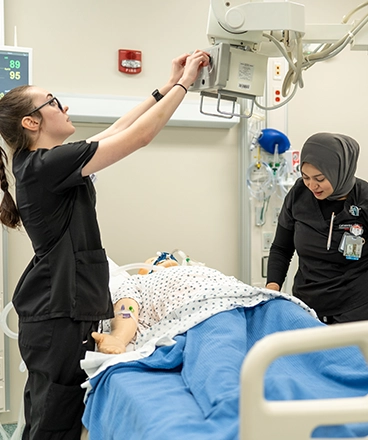
When you study Radiography at CVCC, you’ll learn how to use radiation to create images of tissues, organs, bones, and blood vessels, which are essential for diagnosing and treating patients. The curriculum covers patient care, radiation protection, imaging techniques, equipment maintenance, and professional responsibility. You’ll receive a well-rounded education with classroom instruction, laboratory training, and clinical experiences.
Students will be well-prepared to work in hospitals, clinics, physician’s offices, and more, under the supervision of qualified physicians. Graduates are eligible to take the national exam administered by the American Registry of Radiologic Technologists (ARRT) for certification and registration as medical radiographers.
Beginning in Fall 2026, Catawba Valley Community College will launch a first-of-its-kind Limited Practice Radiography program. CVCC is the first school in North Carolina to offer this program.
The Limited Practice Radiographer curriculum prepares individuals with the foundational knowledge and clinical skills necessary to safely perform quality, limited diagnostic X-ray procedures on selected anatomical sites. Coursework includes radiographic procedures, patient safety and care, radiation protection, and image production and quality. Graduates of programs are prepared for employment in outpatient healthcare settings, and may be eligible to apply for the ARRT Limited X-Ray Machine Operator exam. This curriculum may provide a pathway to advanced study in radiography.
Contacts
Scott Vandevander, Department Head, Allied Health
School of Health Education
828-327-7000 ext. 4075
Please see the catalog for more information about the degree option in this curriculum.
2027 Radiography Application Packet
2027 Limited Practice Program will be added in January of 2027
Information Sessions
Select a date to register:
Monday, September 14, 3:30 PM – 4:30 PM
Monday, October 19, 3:30 PM – 4:30 PM
Monday, November 16, 3:30 PM – 4:30 PM
Monday, December 7, 3:30 PM – 4:30 PM
Tuesday, January 12, 2027, 3:30 PM – 4:30 PM
Wednesday, January 27, 2027, 3:30 PM – 4:30 PM
2027 Radiography Program Requirement Checklist
The following is the most current program effectiveness data. Our programmatic accreditation agency, the Joint Review Committee on Education in Radiologic Technology (JRCERT), defines and publishes this information. The information can be found directly on the JRCERT webpage.
The number of students who pass, on the first attempt, the American Registry of Radiologic Technologists (ARRT) certification examination, or an unrestricted state licensing examination, compared with the number of graduates who take the examination within six months of graduation. The five-year average benchmark established by the JRCERT is 75%.
| Program year | Year | Number passed on first attempt within six months of graduation | Number attempted within six months of graduation | Percent passed |
| 1 | 2021 | 11 | 12 | 92 |
| 2 | 2022 | 11 | 11 | 100 |
| 3 | 2023 | 7 | 7 | 100 |
| 4 | 2024 | 13 | 13 | 100 |
| 5 | 2025 | 10 | 11 | 91 |
Program five-year average pass rate is 96%.
52 students passed within six months of graduation.
54 students attempted the exam within six months of graduation.
The number of graduates employed in the radiologic sciences compared to the number of graduates actively seeking employment in the radiologic sciences within twelve months of graduating. The five-year average benchmark established by the JRCERT is 75%.
| Program year | Year | Number employed within 12 months of graduation | Number actively seeking employment within 12 months of graduation | Percent employed |
| 1 | 2021 | 12 | 12 | 100 |
| 2 | 2022 | 11 | 11 | 100 |
| 3 | 2023 | 7 | 7 | 100 |
| 4 | 2024 | 13 | 13 | 100 |
| 5 | 2025 | 11 | 11 | 100 |
Program five-year average employment rate is 100%.
54 students were employed within 12 months of graduation.
54 students were actively seeking employment within 12 months of graduation.
The number of students who complete the program within the stated program length, excluding those students who
leave the program for nonacademic reasons. The annual benchmark established by the program is 75 %.
| Program year | Year | Number graduated | Number started the program | Percent completed |
| 1 | 2025 | 11` | 11 | 100 |
Annual completion rate is 100%.
LINKS OF INTEREST
» American Society of Radiologic Technologists (ASRT)
» American Registry of Radiologic Technologists (ARRT)
» North Carolina Society of Radiologic Technologists (NCSRT)
» Joint Review Committee on Education in Radiologic Technology (JRCERT)
» Association of Educators in Imaging and Radiologic Sciences
» International Society of Radiographers and Radiologic Technologists
Please see the catalog for more information about the degree option in this curriculum.
20 North Wacker Drive, Suite 2850
Chicago, IL 60606-3182
(312) 704-5300
[email protected]
www.jrcert.org
The program’s current award is 8 Years. General program accreditation information and the current accreditation award letter can be found here.
Next Scheduled Review: 10/2/2027
The radiography program sponsored by CVCC has revised its policy, effective 2016, regarding the placement of students in clinical mammography rotations to observe and/or perform breast imaging. (Additionally, the policy may be applied to any imaging procedures performed by professionals who are of the opposite gender of the patient.)
Under the revised policy, all students, male and female, will be offered the opportunity to participate in clinical mammography rotations. The program will make every effort to place a male student in a clinical mammography rotation if requested; however, the program is not in a position to override clinical setting policies that restrict clinical experiences in mammography to female students. Male students are advised that placement in a mammography rotation is not guaranteed and is subject to the availability of a clinical setting that allows males to participate in mammographic imaging procedures. The program will not deny female students the opportunity to participate in mammography rotations if clinical settings are not available to provide the same opportunity to male students.
The change in the program’s policy regarding student clinical rotations in mammography is based on the sound rationale presented in a position statement on student clinical mammography rotations adopted by the Board of Directors of the Joint Review Committee on Education in Radiologic Technology (JRCERT) at its April 2016 meeting. The JRCERT position statement is included as Addendum A to the program’s policy and is also available on the JRCERT Web site, www.jrcert.org, Programs and Faculty, Program Resources.
Classes are held at the college and clinical experience is gained in area hospitals and doctor’s offices. For students taking the curriculum as outlined, the weekly time commitment varies from 24 hours per week to 34 hours per week.
Clinical facilities now require students to undergo criminal background checks and drug testing. Students will be responsible for the cost of these checks and tests. Students excluded from clinical facilities as a result of positive background checks or drug testing will not be re-assigned to another facility. A student excluded from clinical facilities will not be able to complete clinical requirements of the program and must withdraw from the program. In addition, the American Registry of Radiologic Technologists requires disclosure of any conviction, felony or misdemeanor, on the registry application. At the sole discretion of the Registry, convictions may disqualify the student from the registry examination. Applicants with a felony or misdemeanor conviction should file a pre-application with the American Registry of Radiologic Technologists to determine registry eligibility prior to enrolling in the program (see the ARRT link below).
Radiography students will be required to complete clinical rotations which may require them to travel as much as one hour from campus. All students will also be required to complete rotations during the late afternoon and early evening hours (3:30 PM – 10:00 PM).
CVCC’s Radiography program has provided me with hands-on experience and in-depth knowledge that truly prepares you for the field. The instructors care about your success and push you to be your best.
Ready to take the next step? Whether you’re just starting out or planning a visit, we’re here to help you begin your journey.